Non-Surgical Hair Restoration in Austin and Tysons: What Patients Should Understand Before Choosing a Treatment
What the Non-Surgical Category Includes
Non-surgical hair restoration covers approaches used without a hair transplant, but choosing an option starts with identifying the cause of hair loss. The American Academy of Dermatology describes minoxidil as a treatment applied to the scalp as directed; visible regrowth often takes about 6–12 months. It describes finasteride as a prescription pill approved for male pattern hair loss, with improvement usually noticed after about 4 months. These general estimates are not promises for an individual. Discuss suitability, possible side effects and continued use with a dermatologist rather than selecting a medicine from this article.[aad.org]
Study details matter: findings from one small group using one preparation do not establish that another product or approach will have the same result. Ask which evidence actually matches the option under discussion.[PubMed]
It helps to think of the category in layers. Medications are typically used at home and reviewed over time. Microneedling is an in-office procedure that creates controlled micro-injuries to the scalp. Emerging biologic-adjacent therapies, such as exosome products, are newer and are often discussed alongside microneedling. Each layer differs in how it is delivered, how closely it is monitored, and how mature its published evidence is.[PubMed]
If you are also weighing cost and financing, our companion guide on non-surgical hair restoration cost and financing explains what patients should understand before committing.
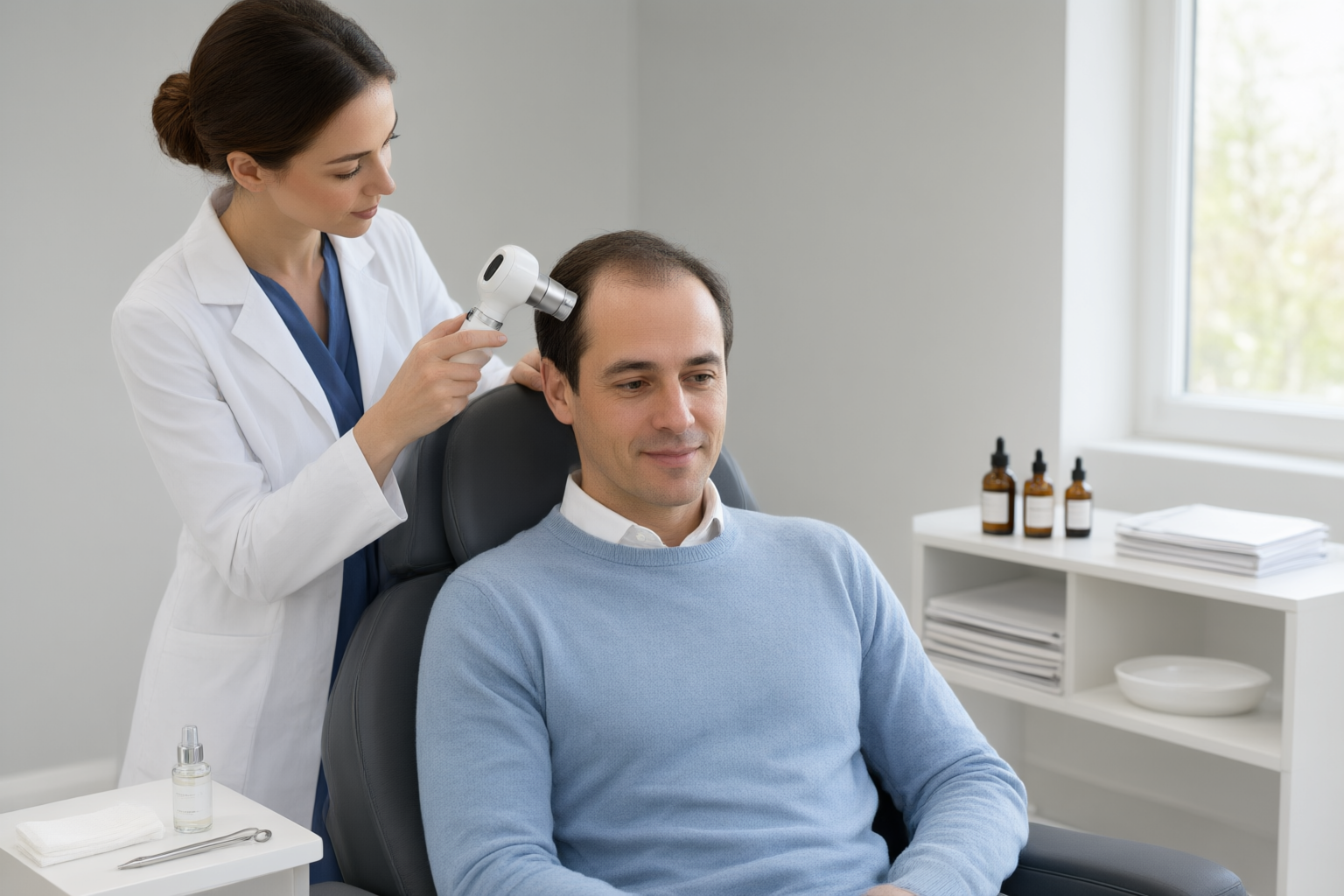
What the Current Evidence Shows — and What It Doesn't
The strength of evidence differs sharply across options. In the cited literature, traditional treatments such as minoxidil and finasteride are described as having limited efficacy and possible side effects. That does not mean they are ineffective for every patient, but it does mean expectations should be set with a clinician rather than from marketing language.[PubMed]
For newer options, the published evidence is early. One prospective, open-label study included 16 male patients aged 36–45 with mild-to-moderate androgenetic alopecia. Microneedling was performed on the scalp, followed by application of a topical exosome therapy. At the 12-month follow-up, the average increase in hair density was about 35 hairs/cm² (standard deviation 6.5 hairs/cm²), with improvements observed in all patients. Reported side effects were mild, including scalp tenderness and slight irritation, and resolved within 48 hours.[PubMed]
Two limits matter. First, this is a single small, open-label study rated Level of Evidence IV, and the authors themselves call for larger samples and longer follow-up before long-term efficacy can be confirmed. Second, the study population was narrow — men aged 36–45 with mild-to-moderate androgenetic alopecia — so results should not be generalized to other patients, other types of hair loss, or other products. Early findings are a reason to ask better questions, not a guarantee.[PubMed]
How the Main Non-Surgical Options Compare
The table below compares option categories by approach, evidence maturity, and follow-up considerations. It is a framework for your own comparison, not a ranking. No option is universally suitable, and individual suitability requires clinical assessment.[PubMed]
| Option category | Approach | Evidence maturity | Follow-up and monitoring |
|---|---|---|---|
| Topical or oral medication (e.g., minoxidil, finasteride) | Minoxidil: applied to the scalp as directed; visible regrowth often takes 6–12 months. Finasteride: prescription pill for male pattern hair loss; improvement usually takes about 4 months (AAD). | AAD describes these medicines as options for appropriate patients. Response and suitability vary; discuss side effects and the need for continued use with a dermatologist. | Ongoing review of response and side effects with a clinician |
| In-office microneedling | Controlled micro-injuries to the scalp during a visit | Often studied in combination with other approaches | Scheduled visits; scalp response and comfort monitored |
| Emerging biologic-adjacent therapy (e.g., exosome products) | Applied after microneedling in the cited study | Early-stage: single small open-label study, Level of Evidence IV | Structured follow-up; results measured over months, not days |
Local Appointment Details to Confirm
Living in Austin, Tysons, or anywhere else does not change what the clinical evidence says. The underlying studies are not location-specific, so a search that includes a city name is really asking a practical question: what can I verify locally before I commit? The useful local factors are practical ones — whether a clinic offers a hair and scalp evaluation, how follow-up and monitoring are structured, and what questions are answered at consultation. This article makes no claim about local providers, pricing, availability, or outcomes.
If you are comparing broader rejuvenation approaches, our guide on surgical vs. non-surgical facial rejuvenation shows how patients structure that kind of comparison.
Questions to Ask Before Choosing an Option
A consultation is the right place to turn general education into a personal decision. These questions are framed for a clinician, not as advice:
Bring the timing and pattern of what you noticed, earlier treatments and the question you most want answered. If you have dated photographs you are comfortable sharing, ask whether they would help the discussion. Different causes can call for different approaches; the presence of a treatment in an article does not establish that the clinic offers it.[aad.org]
Consultation checklist
- What evidence supports this specific option? Ask what published evidence exists for the exact treatment proposed, and at what evidence level.
- What monitoring and follow-up is planned? Ask how often you will be seen and how response will be tracked over time.
- What side effects have been reported? Ask which side effects have been reported for this option and how they are managed if they occur.
- How will results be measured? Ask how improvement will be assessed — for example, photography or scalp assessment — and over what timeframe.
- What happens if it doesn't work? Ask what the plan is if the approach does not produce the response you hoped for.
| Item | Your notes | Question for the clinician |
|---|---|---|
| Timing and pattern | When noticed; areas affected; change over time: ____ | What should be assessed before comparing treatments? ____ |
| Health and treatment context | Medicines, relevant health changes and earlier attempts: ____ | Which details or existing records are useful? ____ |
| What you want to understand | Main concern and realistic change to discuss: ____ | How will the suspected cause influence the options? ____ |
| How progress would be reviewed | Existing photos/notes and date: ____ | How would response, side effects and next steps be assessed? ____ |
Setting Realistic Expectations and Next Steps
Outcomes vary, and early-stage evidence should not be read as a guarantee. Hair loss has multiple causes, and identifying the cause is part of what an individual evaluation is for. A reasonable next step is a consultation for hair and scalp assessment rather than selecting a treatment from an article. If you are comparing newer options specifically, our guide on stem cell vs. exosome hair restoration walks through how patients approach that comparison.
Frequently Asked Questions
Is non-surgical hair restoration effective for everyone?
No. No non-surgical option is universally effective, and hair loss has multiple causes that require individual evaluation. Published evidence for newer options such as exosome therapy comes from small, early-stage studies, so no success rate or guarantee can be offered.
What did the exosome therapy study actually find?
The cited study included 16 men aged 36–45 with mild-to-moderate androgenetic alopecia. At 12 months, the average increase in hair density was about 35 hairs/cm², and reported side effects were mild scalp tenderness and irritation that resolved within 48 hours. It was rated Level of Evidence IV, and the authors called for larger and longer studies. These findings should not be generalized beyond that population.
How do non-surgical options compare with each other?
They differ by approach (at-home medication, in-office microneedling, or emerging biologic-adjacent therapy), by evidence maturity (established use versus early-stage small studies), and by follow-up burden. None is ranked as superior here; suitability is determined in an individual clinical assessment.
Does it matter whether I'm in Austin or Tysons?
The clinical evidence is not location-specific. The practical local questions are whether a clinic offers a hair and scalp evaluation and how follow-up and monitoring are structured. This article makes no claims about specific providers, pricing, or availability.
What should I ask at a consultation?
Ask about the evidence level for the specific option proposed, the planned monitoring and follow-up, reported side effects and how they are managed, how results will be tracked over time, and what happens if the approach does not work.
Can I choose a treatment based on this article?
No. This is general education only, not diagnosis or treatment advice. Treatment selection requires an individual evaluation with a qualified clinician.
References
- A Prospective Study of Exosome Therapy for Androgenetic Alopecia. — pubmed.ncbi.nlm.nih.gov
- Hair loss: Diagnosis and treatment — www.aad.org