Surgical vs. Non-Surgical Facial Rejuvenation: How Patients Compare Their Options
What Does 'Facial Rejuvenation' Actually Cover?
Facial rejuvenation is a broad category rather than a single procedure. It includes surgical options, such as facelift, and non-surgical treatments, which may be topical (creams and peels), injectable (toxins and fillers), or laser-based (such as CO2 resurfacing). These approaches are used by both women and men across a range of ages, and increasing numbers of men are having facial rejuvenation procedures.[source]
Because the category is so broad, the term 'facial rejuvenation' can mean very different things depending on the treatment being discussed. Whether a specific option is appropriate for any one person is determined individually in consultation with a qualified clinician, not from an article.[source]
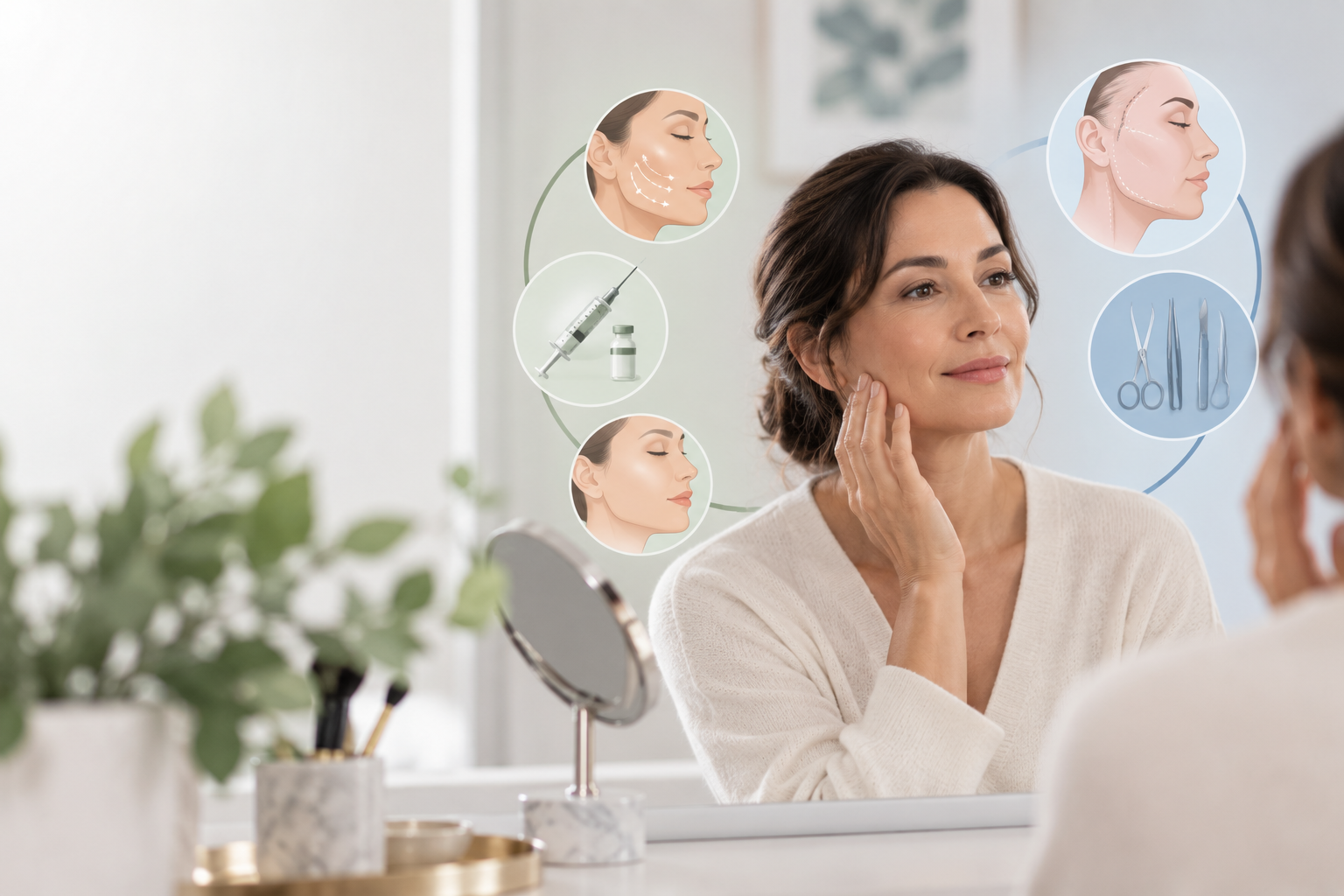
Surgical vs. Non-Surgical Facial Rejuvenation at a Glance
The two categories differ in several practical ways. Non-surgical procedures take place in an office setting without the need for an operating room or anesthesia, and there are no incisions. Surgical procedures, by contrast, involve an operating room and anesthesia. The table below summarizes the general differences described in the supplied sources.[source]
Individual timelines vary, and no timeline should be treated as a promise. The ranges below are general descriptions from the sources, not predictions for any one person.[source]
| Feature | Non-Surgical | Surgical |
|---|---|---|
| Incisions or operating room | No incisions; office setting, no operating room | Involves incisions and an operating room |
| Anesthesia | Not required | Used |
| Downtime / return to work | No downtime described; many can be done during a lunch hour | Downtime expected; return-to-work timing varies |
| When results appear | Toxins take about 3-4 days; fillers are immediate | Results appear after surgery and recovery |
| How long results last | Toxins last about 4-12 months depending on the anatomic area; fillers often need replenishment every 9-12 months and break down faster in areas with more movement | Results are longer lasting, though maintenance may still be needed |
Why Patients Choose Non-Surgical Options First
In a survey of patients seeking total-face non-surgical revitalization, the most common reason for choosing a non-surgical approach was a desire for natural and subtle results. Cost was the second most common factor, followed by having flexibility in treatment choice, concerns about the risks associated with surgery and anesthesia, time away from work and family, the ability to spread treatments out over time, and lastly, scarring concerns.[source]
In open comments, patients also cited concerns such as suboptimal or unnatural facelift results, not being sure they would 'look like me,' fear of a bad outcome, cost, pain avoidance, and a preference for multiple smaller treatments rather than one surgical procedure. These priorities may not generalize to all patients: the survey population was women with a mean age of 53 (range 41-74) at a single non-surgical clinic, and the survey was informal and unvalidated.[source]
Why Some Patients Still Consider Surgery Later
Choosing a non-surgical path first does not necessarily mean surgery is off the table. In the same survey, 47% of respondents had considered facelift surgery, 14% had made inquiries or had consultations with a plastic surgeon, and 44% said they would still consider a facelift later in life.[source]
The source interprets this pattern as suggesting that many patients may view non-surgical treatments as a temporary or delaying option rather than a permanent alternative to surgery. Because the survey was an informal, unvalidated questionnaire of 92 patients at one clinic, these percentages are directional rather than predictive.[source]
How Non-Surgical Treatments Can Affect a Future Facelift
The source raises concerns about how prior non-surgical treatments may affect surgery performed later. Residual filler and threads have been observed during subsequent facelift surgery, sometimes without the surgeon being aware of them beforehand. Biostimulation products and energy-based tightening devices induce collagenesis that may hinder later dissection of tissue planes, and any factor that increases the technical difficulty of surgery may increase the risk of complications.[source]
The author describes a personal practice of advising patients to delay surgical procedures for at least three years after non-surgical lifting or biostimulant procedures. This is one surgeon's stated practice, not a universal guideline, and this article cannot advise any individual on whether or when to sequence treatments. That is a conversation to have with a qualified clinician before starting treatment, not after.[source]
Results, Cost, and Longevity: What the Comparison Does and Does Not Tell You
In general terms, non-surgical methods tend to cost less than traditional surgery, allow for a quicker recovery, and produce a more subtle result. Traditional cosmetic surgery results in a greater degree of change. Non-surgical procedures are described as useful for slight changes, for maintenance of appearance, and as adjuncts to surgical treatment.[source]
This article cannot provide actual prices. Costs vary by provider, region, and treatment plan, and ongoing maintenance costs apply to both pathways. The source also notes that patients need counseling on the continuous, ongoing cost considerations required to maintain the outcomes of both surgical and non-surgical treatments. No guarantee of satisfaction, longevity, or value can be made for either approach.[source]
Questions to Ask Before Choosing a Path
The sources emphasize pre-treatment counseling and individualized planning. The questions below are intended as a discussion checklist for a consultation with a qualified clinician, not as a self-assessment tool.[source][source]
Questions to bring to a consultation
- Does the clinician offer both surgical and non-surgical options? A clinician trained in all aspects of both non-surgical treatments and traditional surgical procedures can help you understand the full range of options.
- How would the plan be individualized to me? Ask how the plan would account for your anatomy, health, budget, and schedule.
- What realistic outcomes and limitations apply? Ask what the treatment can and cannot achieve, and what the expected degree of change is.
- Could I have surgery later, and how might current treatments affect it? Discuss whether future surgery is a possibility and how the treatments you are considering might affect it.
- How would results be maintained over time? Ask about the ongoing maintenance and cost considerations for the path you are considering.
Frequently Asked Questions
Can non-surgical facial rejuvenation replace a facelift?
Non-surgical treatments are generally described as producing a more subtle result and as useful for slight changes, maintenance, and as adjuncts to surgical treatment, while traditional cosmetic surgery results in a greater degree of change. The so-called 'liquid facelift' combines toxins to relax specific facial lines and fillers to add volume, which restores volume and reduces the appearance of wrinkles, but it is not the same as a surgical facelift. Whether one approach is better for you depends on your goals and should be assessed in a consultation with a qualified clinician.
How long do non-surgical facial rejuvenation results last?
According to the supplied source, toxins last anywhere between four and twelve months depending on the anatomic area, and fillers often need replenishment every nine to twelve months. Fillers break down faster in areas that have more movement, such as right around the mouth. These are general ranges, not predictions for any one person, and individual results vary.
Is there downtime after non-surgical facial rejuvenation?
The supplied source describes no downtime after these procedures, and notes that many can even be done during a lunch hour. Bruising is a potential after-effect of any injection and is more common in patients who take blood thinners such as aspirin or herbal remedies. It is best to wait until the following day to apply makeup so that the injection sites may heal. This is a general description and not a promise of a specific recovery experience for any individual.
Does insurance cover facial rejuvenation procedures?
The supplied source indicates that these procedures are considered cosmetic and are not covered by insurance. Coverage determinations depend on the specific procedure and the individual's plan, so readers should verify with their own insurer rather than relying on this general statement.
If I start with non-surgical treatments, can I still have surgery later?
The survey evidence found that 44% of respondents said they would still consider a facelift later in life, and the source advises discussing the possibility of future surgery before starting non-surgical treatments that could complicate later surgery. The source author describes a personal practice of advising a delay of at least three years after non-surgical lifting or biostimulant procedures, but this is one clinician's practice rather than a universal rule. This article cannot advise any individual on sequencing; that discussion belongs in a consultation with a qualified clinician.
References
- Surgical or Nonsurgical Facial Rejuvenation: The Patients’ Choice - PMC — pmc.ncbi.nlm.nih.gov
- FAQs about Non-Surgical Facial Rejuvenation | Renaissance School of Medicine at Stony Brook University — renaissance.stonybrookmedicine.edu